Software Defined Instrumentation · Working Requirements
Orchestra — System Requirements
Draft 0.1 · 21 October 2026 · Architecture baseline for review
Orchestra is an instrument operating system that assembles measurement and stimulus capabilities from independent software and hardware modules. It separates setup and display, measurement acquisition, local real-time control, processing, and communication so that each can evolve without redesigning the whole instrument.
Architectural rule: Define the measurement in a universal language; execute time-critical operations locally; transport information over interchangeable communications media.
Purpose and Scope
This document states what the Orchestra system must accomplish. It deliberately does not select a processor, FPGA, ADC, connector, radio, programming language, or operating system. Those are implementation choices to be evaluated against these requirements.
The first prototype must demonstrate modularity with simulated and physical test heads, local triggering, buffered acquisition, and at least two interchangeable communications media. Higher measurement bandwidth and more sophisticated heads are subsequent refinements.
System Organization
SYS-001 Orchestra shall separate the operator setup/display functions from physical detection, triggering, and stimulus interfaces.
SYS-002 Orchestra shall support independently implemented modules for measurement heads, stimulus heads, local clusters, communication interfaces, processing services, and user interfaces.
SYS-003 A module shall declare its identity, capabilities, limits, configuration options, and operating status through the system language.
SYS-004 Modules and clusters shall be replaceable without changing the meaning of their externally defined commands or measurement records.
SYS-005 Orchestra shall permit local, remote, and separately hosted processing and display functions.
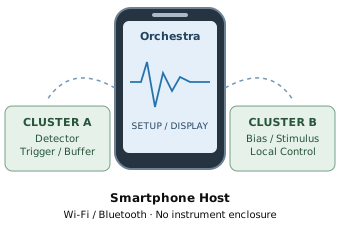
Host
The Orchestra Host is the general-purpose computing device
used to operate the instrumentation system. It provides
the operator interface and may contribute communication,
processing, storage, and network resources according to
its capabilities.
The Host is not a dedicated instrument enclosure.
Smartphones, tablets, laptops, desktop computers, and
workstations may serve as Orchestra Hosts. Instrumentation
clusters remain responsible for their own real-time
acquisition, triggering, and local hardware control.
HOST-001 — Host Independence
Orchestra shall support operation on compatible
general-purpose computing devices without requiring
modifications to the Universal Instrument Language
or instrumentation clusters.
HOST-002 — Existing Operating Systems
Orchestra shall utilize existing host operating-system
services, including communications, networking, file
management, and processing, rather than require a
dedicated operating system.
HOST-003 — Browser Interface
Orchestra shall support a browser-based operator
interface for instrument setup, control, display,
and interactive analysis.
HOST-004 — Portable Operation
Orchestra shall support standalone field configurations
using a compatible smartphone or tablet communicating
directly with one or more instrumentation clusters,
without requiring an intermediate computer or
internet connection.
HOST-005 — Host Resources
Orchestra shall permit available host resources to
perform measurement processing, data reduction,
visualization, and storage. These functions shall
not require a dedicated external processor.
HOST-006 — Communication Independence
Host selection shall not dictate the Universal
Instrument Language. Communication interfaces shall
accommodate the physical and software capabilities
of the selected host.
HOST-007 — Scalable Processing
Orchestra shall permit processing and storage functions
to be performed locally or delegated to external
computing resources without changing the measurement
interfaces.
HOST-008 — Operational Continuity
Loss of host communication shall not compromise local
measurement integrity or leave connected instrumentation
in an unsafe operating state.
Architectural Principle:
The Host provides resources. Orchestra defines instrument
behavior. The Cluster performs the measurement.
Universal Instrument Language
LANG-001 A versioned, transport-independent message syntax shall define commands, responses, events, status, and measurement records.
LANG-002 The language shall support discovery, capability reporting, configuration, arming, trigger reporting, data retrieval, stimulus control, diagnostics, and clock-related operations.
LANG-003 Messages shall include sufficient identification, type, length, and sequence information to detect duplication, omission, or misassociation at the application level.
LANG-004 Measurement records shall identify quantity, units, acquisition settings, timestamp basis, and applicable calibration and uncertainty metadata.
LANG-005 Unknown or unsupported commands and version differences shall produce explicit, machine-readable outcomes rather than silent reinterpretation.
LANG-006 Physical and simulated modules providing equivalent declared capabilities shall use compatible language interfaces.
System Backbone and Communication Interfaces
COM-001 Orchestra shall not require a particular communication medium. Candidate media include USB, Wi-Fi, Ethernet, Bluetooth, and fiber.
COM-002 A communication interface shall manage its medium-specific signaling, framing, buffering, error detection, link timing, flow control, and applicable retransmission mechanisms.
COM-003 A communication interface shall expose its usable throughput, latency characteristics, connection state, and transport errors to the system where measurable.
COM-004 The system shall distinguish transport delivery timing from measurement event timing.
COM-005 Communication media may provide power, provided their power limits, reference connections, and isolation properties are declared and enforced.
COM-006 The language shall retain end-to-end message identity and measurement validity independently of link-level integrity checking.
Local Instrumentation Clusters
CLU-001 A cluster shall support local real-time control independently of Orchestra's polling schedule.
CLU-002 Clusters may use microcontrollers, processors, FPGAs, or combinations thereof, provided they satisfy their declared behavior.
CLU-003 An Extended Backbone may distribute local serial communications, ground/common, power, reference oscillator, trigger, and additional application-specific signals.
CLU-004 Each Extended Backbone connection shall have an explicit electrical and timing definition; no shared ground, power, or clock connection shall be presumed.
CLU-005 A cluster shall report which heads share a timing domain, trigger domain, electrical reference domain, and power domain.
CLU-006 A cluster shall buffer acquired data until retrieved or until a declared resource limit is reached, and shall report overflow or loss.
Timing, Triggering, and Acquisition
TIME-001 Time-critical trigger detection and sample capture shall be performed within the local cluster or measurement head, not depend on host polling latency.
TIME-002 Acquired events shall carry timestamps or sample-index relationships referenced to an identified local clock.
TIME-003 The system shall describe the relationship between clocks when records from different timing domains are compared, including known uncertainty and drift.
TIME-004 Common triggers and common oscillators shall be treated as distinct capabilities; sharing one shall not imply sharing the other.
TIME-005 Heads shall declare acquisition rate, resolution, input limits, trigger behavior, buffering capacity, and relevant timing errors.
TIME-006 Continuous acquisition and triggered-record acquisition shall be supported as separate operating modes where the head permits them.
Electrical References, Isolation, and Safety
ELEC-001 Each head shall declare its electrical reference and isolation characteristics, including any galvanic connection introduced by communications or power.
ELEC-002 Shared bias, stimulus, and measurement references shall be established deliberately within a declared electrical domain.
ELEC-003 Floating operation shall be claimed only when the complete head, power, communication, and input configuration supports it.
ELEC-004 The system shall expose relevant voltage, current, thermal, and protection limits and shall not treat software configuration as a substitute for hardware protection.
Processing, Display, and Simulation
APP-001 Setup and display shall operate on general-purpose computing devices with suitable input and display facilities.
APP-002 Data processing may execute on the display device, a separate computer, or another accessible processing resource.
APP-003 A simulator shall be able to provide declared measurement-head or cluster behavior through the same external language.
APP-004 Simulated data shall be identifiable as simulated and shall not be represented as physical measurement data.
APP-005 Orchestra shall support the incorporation of existing computer-controllable instruments through compatible adapters.
External Instrument Compatibility
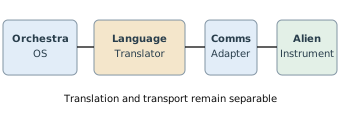
Existing computer-controllable instruments may join Orchestra through an optional language translator. Translation is independent of the communication adapter: the translator maps instrument commands, capabilities, responses, and errors into the Universal Instrument Language, while the adapter manages the physical transport. Native Orchestra modules require no translator.
INT-001 Orchestra shall support independently replaceable translation modules that map external instrumentation commands, capabilities, measurement data, and error conditions into the Universal Instrument Language without requiring changes to the Orchestra operating system or System Backbone.
INT-002 Translation modules shall declare unsupported functions and shall preserve or explicitly report the limitations of measurement timing, accuracy, units, and data provenance.
INT-003 Language translation and communication transport shall remain independently replaceable functions.
Operational Integrity and Extensibility
OPS-001 Each acquisition session shall have an identifiable configuration and an explicit lifecycle such as configured, armed, acquiring, completed, or failed.
OPS-002 The system shall detect and report unavailable modules, transport disconnection, incomplete records, and buffer overflow.
OPS-003 Commands that alter outputs, bias, or stimulus shall have defined authorization, limits, and safe behavior on communication loss.
OPS-004 Language and capability versioning shall allow future hardware generations without invalidating previously defined measurements.
Initial Verification Demonstration
The first development system shall demonstrate the architecture before pursuing maximum bandwidth:
| Test | Required demonstration |
|---|
| Module interchange | Replace a simulated detector with a physical detector while retaining the same application-level measurement workflow. |
| Transport interchange | Run an equivalent session over USB and Wi-Fi without changing the instrument language. |
| Local trigger | Capture and timestamp an event while host polling is delayed; retrieve it afterward. |
| Shared reference | Configure two heads with a declared common electrical reference and trigger relationship. |
| Separated reference | Identify an electrically isolated head and correctly report its distinct reference domain. |
| Fault handling | Disconnect a link or overflow a buffer and report the condition without silently presenting a complete record. |
| Remote processing | Analyze a retrieved measurement record separately from the setup/display process. |
Open Design Decisions
The following are intentionally not yet specified: binary packet encoding; message framing and schema; minimum clock stability; synchronization mechanism; bandwidth targets for individual head families; Extended Backbone connector and pinout; isolation classes; host discovery mechanisms; authentication; and the division between open and proprietary interfaces. These belong in the subsequent Specifications and Operation brief and its engineering revisions.
Development principle: Specify the interface, simulate the behavior, demonstrate the mechanism, then improve the hardware. Measurement capability may advance without replacing the Orchestra operating system.